Text as mask — fill, blur, spotlight
Text becomes a stencil: render glyphs to an alpha-coverage texture,
feed any other render-texture as the foreground, and
Renderer::apply_mask_to_texture clips the foreground to the
glyph shape. The story below shows the same "WISP" mask with three
foregrounds — a saturated color-band fill, a blurred backdrop, and
a warm spotlight.
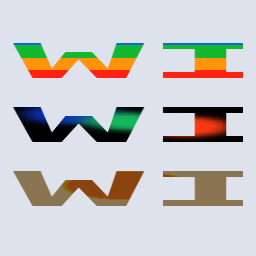
Top: gradient fill through text. Middle: blurred circles. Bottom: warm spotlight. One mask, three foregrounds.
Composition
sequenceDiagram
    participant Pipe as TextTexturePipeline
    participant Mask as mask_rt (RGBA, alpha = glyph coverage)
    participant Fg as foreground_rt (gradient | blur | spotlight)
    participant Compose as Renderer.apply_mask_to_texture
    participant Out as output_rt

    Pipe->>Mask: text → RT with alpha = coverage
    Fg->>Compose: pass through unchanged
    Mask->>Compose: clip with alpha
    Compose->>Out: foreground × mask.a
This is the same function M-VEC.4..6 (privacy blur / redaction / spotlight composition) and M-MASK.2..4 (clip + path mask + mask combine) call. Text joins the list of valid coverage sources alongside analytic SDFs (RoundedRect, Ellipse), vector paths, and procedural masks. The renderer doesn't care where the alpha came from.
API
#![allow(unused)]
fn main() {
use wisp::text::{TextTexturePipeline, WispText, WispTextStyle};
use wisp::{RenderTexture, Texture, Color};

// 1. Render text to a coverage texture.
let text = WispText::new("WISP").with_style(
    WispTextStyle::default().with_size(0.95).with_color(Color::WHITE),
);
let text_rt = pipeline.render(app, &text, 256, 256);

// 2. Stage the text-RT into the renderer's format (linear, +y up).
let mask_rt = RenderTexture::with_format(app, 256, 256, format);
// (render text_rt onto mask_rt via a sprite with scale.y = -1)

// 3. Apply the mask to any foreground RT.
let output = RenderTexture::with_format(app, 256, 256, format);
renderer.apply_mask_to_texture(app, &foreground_rt, &mask_rt, &output);
}
Three pre-made foregrounds
The three foregrounds in the story are independent of the mask. Swap
the gradient for a screen-grab, the blur for a stock photo, the
spotlight for a vignette — and the same apply_mask_to_texture call
just works. Caching the mask RT across frames (text is rarely
re-rendered per frame) and only regenerating the foreground keeps
the GPU cost in line with a regular textured sprite.
- Fill — A
Graphicsof horizontal color bands rendered into a plain RT. Punchy, poster-style. - Blur — Three overlapping
draw_ellipsecircles in saturated colors, run throughBlurFilter::new(radius: 8.0). Soft-focus reveal. - Spotlight — Solid warm field + a yellow ellipse + a slight
dimming layer, finished with a zero-offset
DropShadowFilterto soften. Glowy halo through the glyphs.
Lavapipe / CI guard
The blur + drop-shadow paths use the multi-bind-group filter
pipeline that lavapipe (Linux CI's software Vulkan) loses the device
on. The story checks WISP_SKIP_GPU_FILTER_TESTS and substitutes a
sharp / no-filter foreground when it's set, so the smoke + snapshot
tests still pass on the Ubuntu runner. macOS runners exercise the
real filter path.
Pixel tests
Inside-/outside-glyph alpha is enforced upstream by the mask-compose
pipeline's own tests
(crates/wisp/tests/mask_compose_*.rs).
This chunk verifies that text-driven masks reach the same primitive
unchanged, by way of the storybook story's story_smoke (no wgpu
validation errors, visible pixels) and story_fingerprints (quadrant
snapshot — text shape must be stable per frame).